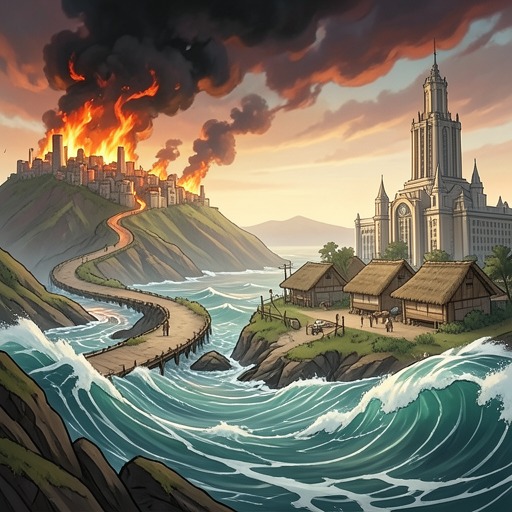
at the beginning of time
World Creation
From puru chu dokon, the divine ordering power separates fire, air, earth, and water, establishes the heavens, seas, winds, stars, and living creatures, and shapes humanity from earthly and celestial substance. The world becomes a structured cosmos whose forms remain capable of change
the first ages after creation
Ages of Humanity
Humanity passes from the peaceful [Golden Age](entity:expression-recall-expression-golden-age-cfd28df8645f) through the Silver and Bronze Ages into the violent [Iron Age](entity:expression-recall-expression-iron-age-ab6c95a8a7f4). Law, greed, seafaring, mining, warfare, fraud, and sacrilege replace communal innocence, while Justice withdraws from Earth.
during the Iron Age
The Giants' Assault
[Giants](entity:creature-recall-creature-1b8ac7e5d872) pile mountains upon mountains in an attempt to storm [Heaven](entity:location-recall-location-heaven-0167f964ad61). [Jupiter](entity:character-recall-character-jupiter-ad236da3be58) destroys their constructions with thunderbolts, and their blood mingled with earth produces another violent race, confirming that rebellion and bloodshed have become endemic
after the Giants' defeat
Lycaon Punished
[Jupiter](entity:character-recall-character-jupiter-ad236da3be58) visits the human world in disguise and finds [Lycaon](entity:character-recall-character-lycaon-a61df6d53085) guilty of impiety, murder, and cannibalistic hospitality. He burns the palace and transforms Lycaon into a wolf, then tells the [Council of the Gods](entity:organization-recall-organization-council-of-the-g-054beb7b911a) that corrupted humanity must be destroyed.
immediately after Jupiter's judgment
The Flood
[Jupiter](entity:character-recall-character-jupiter-ad236da3be58) abandons the plan to burn the world and instead unleashes the waters, aided by [Neptune](entity:character-recall-character-neptune-006f5db74c38). Rivers overflow, seas cover fields and cities, animals and people perish, and the earth becomes a single waterlogged wilderness.
after the Flood recedes
Deucalion and Pyrrha Repeople Earth
Dewkalion and Pila, the only surviving human pair, consult [Themis](entity:character-recall-character-themis-ac169e923966). Interpreting her command to cast their mother's bones behind them as stones from the earth, they throw rocks that soften and become men and women, while other animals arise from sun-warmed mud
soon after humanity is restored
Apollo Kills Python
A gigantic serpent born from the flood's mud threatens the new world. [Apollo](entity:character-recall-character-apollo-1cf2b99589fd) kills Python with repeated arrows and establishes the Pythian games, turning the monster's destruction into a lasting ritual of athletic and poetic remembrance.
after Python's death
Apollo Pursues Daphne
[Cupid](entity:character-recall-character-cupid-e025d638b7ec) wounds [Apollo](entity:character-recall-character-apollo-1cf2b99589fd) with a golden arrow of desire and [Daphne](entity:character-recall-character-daphne-5e89dfbf7f6c) with a leaden arrow of rejection. Apollo pursues her through the wilderness, while Daphne, devoted to virgin freedom, calls on her father and the river powers to save her.
at the end of the pursuit
Daphne Becomes Laurel
[Daphne](entity:character-recall-character-daphne-5e89dfbf7f6c)'s body hardens into bark, her hair becomes leaves, and her arms become branches. [Apollo](entity:character-recall-character-apollo-1cf2b99589fd) cannot possess her as a woman, so he claims the laurel as his sacred tree and makes it the emblem of poets, victors, and Roman triumph.
after Apollo and Daphne
Jupiter and Io
[Jupiter](entity:character-recall-character-jupiter-ad236da3be58) seduces [Io](entity:character-recall-character-io-3c4f9a3ba003) and hides their encounter beneath a cloud, but [Juno](entity:character-recall-character-juno-6875ac1ce190) suspects the deception. Jupiter transforms Io into a heifer to conceal her, yet Juno claims the animal and places her under [Argus](entity:character-recall-character-argus-eb5738a05d7d)'s guard.
during Io's captivity
Mercury Kills Argus
[Mercury](entity:character-recall-character-mercury-dc08adc34fea) arrives disguised as a shepherd and lulls [Argus](entity:character-recall-character-argus-eb5738a05d7d)'s many eyes to sleep with music and stories, including the transformation of [Syrinx](entity:character-recall-character-syrinx-ce3eea04beec) into reeds. He then kills Argus, freeing [Io](entity:character-recall-character-io-3c4f9a3ba003) from immediate surveillance.
after Argus's death
Io Restored
[Juno](entity:character-recall-character-juno-6875ac1ce190) torments [Io](entity:character-recall-character-io-3c4f9a3ba003) with wandering madness until the heifer reaches Egypt. [Jupiter](entity:character-recall-character-jupiter-ad236da3be58) persuades Juno to relent, and Io regains human form, becomes a goddess, and is worshipped with her son Epaphus.
after Io's restoration
Phaethon Claims His Father
Epaphus mocks [Phaethon](entity:character-recall-character-phaethon-c572c28d77dc)'s claim to be the Sun's son. Phaethon asks his mother Clymene for proof, visits Phoebus's palace, and receives confirmation from the Sun, who swears to grant any request.
the next dawn
Phaethon Drives the Sun Chariot
[Phaethon](entity:character-recall-character-phaethon-c572c28d77dc) asks to drive the sun chariot for one day. Unable to control the horses, he leaves the proper course, scorching mountains, rivers, cities, and continents and threatening the entire cosmic order
later that same day
Jupiter Strikes Phaethon
To prevent universal destruction, [Jupiter](entity:character-recall-character-jupiter-ad236da3be58) hurls the thunderbolt at [Phaethon](entity:character-recall-character-phaethon-c572c28d77dc). The youth falls dead into the western river, while the Sun and the world mourn the catastrophe caused by filial pride and reckless ambition.
after Phaethon's death
Phaethon's Sisters Become Trees
Clymene and her daughters mourn beside [Phaethon](entity:character-recall-character-phaethon-c572c28d77dc)'s tomb. The sisters gradually root into the earth and become trees that bleed amber when their bark is torn, while Cycnus becomes a swan and retreats from fire-loving lands.
after the Sun's course is restored
Callisto Violated
[Jupiter](entity:character-recall-character-jupiter-ad236da3be58) sees Callisto, a huntress devoted to [Diana](entity:character-recall-character-diana-baf651a1725a), and disguises himself as Diana to approach her. He overpowers and seduces her, and Callisto later becomes pregnant, making her exclusion from Diana's bathing company unavoidable.
months after the assault
Callisto Becomes a Bear
[Juno](entity:character-recall-character-juno-6875ac1ce190) discovers Callisto's pregnancy and transforms her into a bear, leaving her conscious but speechless and hunted by beasts and men. Years later Callisto's son nearly kills her, but [Jupiter](entity:character-recall-character-jupiter-ad236da3be58) saves them both and places them among the stars.
during Apollo's early adulthood
Coronis Dies
The raven reports that [Coronis](entity:character-recall-character-coronis-0e8384deacde) has taken another lover. [Apollo](entity:character-recall-character-apollo-1cf2b99589fd), enraged, kills Coronis with an arrow, then regrets the act when she reveals that their unborn child has done nothing wrong.
immediately after Coronis's death
Asclepius Is Born
[Apollo](entity:character-recall-character-apollo-1cf2b99589fd) rescues the unborn child from [Coronis](entity:character-recall-character-coronis-0e8384deacde)'s body and gives him to [Chiron](entity:character-recall-character-chiron-987c8b02863d). The child, [Asclepius](entity:character-recall-character-asclepius-2125aa2b02f7), becomes a physician capable of healing the dead, a power that later provokes [Jupiter](entity:character-recall-character-jupiter-ad236da3be58)'s anger and leads to his own divine elevation.
during Asclepius's childhood
Ocyrhoe Becomes a Mare
[Chiron](entity:character-recall-character-chiron-987c8b02863d)'s prophetic daughter [Ocyrhoe](entity:character-recall-character-ocyrhoe-2fa7755939b2) foresees [Asclepius](entity:character-recall-character-asclepius-2125aa2b02f7)'s future, including his death and resurrection, and predicts Chiron's eventual end. Her prophecy violates divine secrecy; she begins to change into a mare and loses human speech.
after Mercury steals Apollo's cattle
Battus Becomes Stone
[Mercury](entity:character-recall-character-mercury-dc08adc34fea) bribes [Battus](entity:character-recall-character-battus-eca39e36e0f1) to conceal a cattle theft, then returns in disguise and offers a larger bribe. Battus betrays the secret twice, so Mercury turns him into a touchstone, making his treachery permanent in both body and name.
during Mercury's courtship of Herse
Aglauros Becomes Stone
[Mercury](entity:character-recall-character-mercury-dc08adc34fea) seeks access to Herse, but [Aglauros](entity:character-recall-character-aglauros-5bf5e7b58158) demands payment and blocks him. [Minerva](entity:character-recall-character-minerva-fc023ce135f2) summons Envy, whose poison consumes Aglauros with jealousy until Mercury makes her immobile and transforms her into stone.
after Mercury's visit to Athens
Europa Is Abducted
At [Jupiter](entity:character-recall-character-jupiter-ad236da3be58)'s command, [Mercury](entity:character-recall-character-mercury-dc08adc34fea) drives cattle toward [Sidon](entity:location-recall-location-sidon-29af71c97530). Jupiter disguises himself as a gentle white bull, wins [Europa](entity:character-recall-character-europa-d26efc0d5276)'s confidence, carries her across the sea, and reveals his divine form on [Crete](entity:location-recall-location-crete-db0e67d7a50e).
after Europa's abduction
Cadmus Founds Thebes
[Cadmus](entity:character-recall-character-cadmus-50f7279c2a23) searches for [Europa](entity:character-recall-character-europa-d26efc0d5276) and receives an oracle directing him to follow a cow and build where it rests. His companions are killed by Mars's dragon, which Cadmus slays; he sows its teeth, and the resulting warriors fight until five survive to help found [Thebes](entity:location-recall-location-thebes-287d4a7870ec).
during Cadmus's reign
Actaeon Sees Diana
While hunting, [Actaeon](entity:character-recall-character-actaeon-0903a288e81a) accidentally enters [Diana](entity:character-recall-character-diana-baf651a1725a)'s private bathing place and sees the goddess naked. Diana splashes water onto him, transforming him into a stag before he can explain his ignorance.
immediately after his transformation
Actaeon Is Hunted
[Actaeon](entity:character-recall-character-actaeon-0903a288e81a)'s own hounds chase and tear apart the stag he has become. His servants call for their absent master while the transformed hunter dies unable to speak, making the punishment a tragedy of accidental sight rather than deliberate offense.
during Bacchus's infancy
Semele Dies and Bacchus Is Born
[Juno](entity:character-recall-character-juno-6875ac1ce190) disguises herself as [Semele](entity:character-recall-character-semele-c462b9a098bf)'s nurse and persuades her to demand that [Jupiter](entity:character-recall-character-jupiter-ad236da3be58) appear in full divine majesty. The mortal Semele is consumed by his lightning, but Jupiter rescues the unborn child and carries him to term in his thigh.
after Bacchus's birth
Tiresias Loses Sight
[Tiresias](entity:character-recall-character-tiresias-7cd16b269ced), who has experienced life as both sexes after striking paired serpents, judges that women experience greater sexual pleasure. [Juno](entity:character-recall-character-juno-6875ac1ce190) blinds him for siding with [Jupiter](entity:character-recall-character-jupiter-ad236da3be58), while Jupiter grants him inward prophetic sight.
during Narcissus's sixteenth year
Narcissus and Echo
The nymph [Echo](entity:character-recall-character-echo-748e2d408c30), cursed by [Juno](entity:character-recall-character-juno-6875ac1ce190) to repeat others' words, falls in love with [Narcissus](entity:character-recall-character-narcissus-8ac539c49d81) but cannot speak independently. He rejects her, and she wastes away until only her bones and echoing voice remain.
soon after Echo's rejection
Narcissus Dies
[Narcissus](entity:character-recall-character-narcissus-8ac539c49d81) sees his reflection in a clear spring and falls in love with the image without recognizing himself. Unable to possess it, he wastes away beside the water; his body disappears and a flower rises in its place.
during Bacchus's triumphal progress
Pentheus Rejects Bacchus
[Pentheus](entity:character-recall-character-pentheus-11e673e6ea67) mocks the worship of [Bacchus](entity:character-recall-character-bacchus-24aa88243a9d) and refuses to accept the god's divinity. Despite [Tiresias](entity:character-recall-character-tiresias-7cd16b269ced)'s warning, he orders the god's followers seized and goes personally to witness the ecstatic rites.
during Pentheus's challenge to Bacchus
Sailors Become Dolphins
[Acoetes](entity:character-recall-character-acoetes-91d1cfa104c2) recounts how Tyrrhenian sailors abducted [Bacchus](entity:character-recall-character-bacchus-24aa88243a9d) and tried to sail to [Naxos](entity:location-recall-location-naxos-6df8504da4e8) while ignoring his command. Ivy covers their ship, the god reveals himself, and the crew leap into the sea and become dolphins; Acoetes alone is spared.
immediately after the sailors' tale
Pentheus Is Torn Apart
[Pentheus](entity:character-recall-character-pentheus-11e673e6ea67) rejects [Acoetes](entity:character-recall-character-acoetes-91d1cfa104c2)'s warning and confronts the [Bacchae](entity:organization-recall-organization-bacchae-523019fff5a8). His mother Agave, maddened by divine frenzy, mistakes him for a wild boar; she and the other women tear him limb from limb before [Thebes](entity:location-recall-location-thebes-287d4a7870ec) finally acknowledges [Bacchus](entity:character-recall-character-bacchus-24aa88243a9d).
during the daughters of Minyas' storytelling
Pyramus and Thisbe Die
[Pyramus and Thisbe](entity:event-recall-event-660178bf4b41) love across a wall their parents forbid them to cross. A lioness stains [Thisbe](entity:character-recall-character-thisbe-2cfe85e2bc80)'s veil, [Pyramus](entity:character-recall-character-pyramus-c72f3d6fcd29) mistakes it for proof of her death and kills himself, and Thisbe follows after discovering the truth; the mulberry's fruit turns purple from their blood.
after Pyramus and Thisbe
Leucothoe Becomes Frankincense
The Sun disguises himself as [Leucothoe](entity:character-recall-character-leucothoe-b92f0e09b4fe)'s mother and seduces her. [Clytie](entity:character-recall-character-clytie-67e93baca5cf) exposes the affair, and Leucothoe's father buries her alive; [Apollo](entity:character-recall-character-apollo-1cf2b99589fd) opens the earth too late and transforms her body into a frankincense tree.
after Leucothoe's death
Clytie Becomes Heliotrope
[Clytie](entity:character-recall-character-clytie-67e93baca5cf) continues watching the Sun while refusing food and shelter. Her body roots into the ground and becomes the heliotrope, whose flowers follow the Sun across the sky.
during the daughters of Minyas' stories
Salmacis and Hermaphroditus Unite
[Salmacis](entity:character-recall-character-salmacis-b5154828aaa3) desires [Hermaphroditus](entity:character-recall-character-hermaphroditus-722df64373f2), the beautiful child of [Mercury](entity:character-recall-character-mercury-dc08adc34fea) and [Venus](entity:character-recall-character-venus-c3ad2d1b04e1), but he rejects her advances. She clings to him in a spring and prays never to be separated; the gods fuse their bodies into one being with both sexes.
at the height of Bacchus's festival
Minyas's Daughters Become Bats
The daughters of Minyas continue weaving while refusing to worship [Bacchus](entity:character-recall-character-bacchus-24aa88243a9d). Vines, ivy, torches, and phantom beasts invade their chamber; as they flee, their arms become wings and they become bats that fly at dusk.
after Pentheus's death
Ino and Melicerta Become Sea Gods
[Juno](entity:character-recall-character-juno-6875ac1ce190) sends the [Furies](entity:creature-recall-creature-5fbcfa782f68) to drive Athamas and [Ino](entity:character-recall-character-ino-d21f77d27c7e) mad. Athamas kills their son Learchus, and Ino leaps into the sea with [Melicerta](entity:character-recall-character-melicerta-d9d0888fa2b2); [Venus](entity:character-recall-character-venus-c3ad2d1b04e1) asks [Neptune](entity:character-recall-character-neptune-006f5db74c38) to save them, and they become the marine gods [Leucothoe](entity:character-recall-character-leucothoe-b92f0e09b4fe) and Palaemon.
late in Cadmus's life
Cadmus and Harmonia Become Snakes
After the disasters that afflict his family, [Cadmus](entity:character-recall-character-cadmus-50f7279c2a23) wishes to become the serpent he once killed. His body becomes scaled and tailed; [Harmonia](entity:character-recall-character-harmonia-3914773dd4c3) asks to share his fate, and she too becomes a serpent, the pair retaining their affection in their new form.
after Cadmus and Harmonia's transformation
Perseus Rescues Andromeda
[Perseus](entity:character-recall-character-perseus-2c4991cc67f1) reaches Ethiopia and sees [Andromeda](entity:character-recall-character-andromeda-213860b2cdab) chained to a rock as a sacrifice for her mother's boast. He bargains for her hand, attacks the sea monster from the air, kills it, and receives Andromeda as his bride.
during the wedding feast with Andromeda
Perseus Kills Medusa
At the feast, [Perseus](entity:character-recall-character-perseus-2c4991cc67f1) recounts his journey to the [Gorgons](entity:creature-recall-creature-f965c3bb1ee5). Using the reflection in [Perseus's shield](entity:object-recall-object-perseus-s-shield-337fb4ce1943), he beheads [Medusa](entity:character-recall-character-medusa-2e313bbd62df) while she sleeps; her blood produces Pegasus, and her severed head retains the power to petrify whoever looks upon it.
on Perseus's return flight
Perseus Petrifies Atlas
[Atlas](entity:character-recall-character-atlas-a722d3e469d6) refuses [Perseus](entity:character-recall-character-perseus-2c4991cc67f1) hospitality because an oracle foretold that [Jupiter](entity:character-recall-character-jupiter-ad236da3be58)'s descendant would seize his golden trees. Perseus reveals [Medusa's head](entity:object-recall-object-medusa-s-head-6c41d3c18069), turning Atlas into the mountain that thereafter supports the heavens.
at the wedding of Perseus and Andromeda
Perseus's Wedding Battle
Phineus attacks [Perseus](entity:character-recall-character-perseus-2c4991cc67f1), claiming [Andromeda](entity:character-recall-character-andromeda-213860b2cdab) as his promised bride. Perseus fights through the palace and finally displays [Medusa's head](entity:object-recall-object-medusa-s-head-6c41d3c18069), petrifying Phineus and the remaining attackers.
during Minerva's visit to Mount Helicon
Arachne Challenges Minerva
[Arachne](entity:character-recall-character-arachne-9d7ed286db7e), a mortal weaver from Lydia, claims superiority to [Minerva](entity:character-recall-character-minerva-fc023ce135f2) and refuses to repent. The goddess disguises herself as an old woman, warns her, then reveals her identity when Arachne persists.
immediately after the weaving contest
Arachne Becomes a Spider
[Arachne](entity:character-recall-character-arachne-9d7ed286db7e)'s tapestry truthfully depicts the gods' seductions, while [Minerva](entity:character-recall-character-minerva-fc023ce135f2)'s work celebrates divine authority. Enraged despite recognizing the mortal's skill, Minerva strikes Arachne and transforms her into a spider condemned to weave forever.
during the generation after Cadmus
Niobe's Children Are Slain
[Niobe](entity:character-recall-character-niobe-ace74315e2d8) boasts that her fourteen children make her superior to Latona, who has only [Apollo](entity:character-recall-character-apollo-1cf2b99589fd) and [Diana](entity:character-recall-character-diana-baf651a1725a). The divine twins answer the insult by killing all Niobe's sons and daughters with their arrows, leaving her house desolate.
immediately after her children's deaths
Niobe Becomes Stone
[Niobe](entity:character-recall-character-niobe-ace74315e2d8)'s grief hardens her body into a living statue. Though her limbs, blood, speech, and movement disappear, tears continue to flow from the stone figure on her lonely mountain.
after Niobe's punishment
Lycia Peasants Become Frogs
The Lycian peasants refuse Latona water and muddy the lake while she carries her twins. Latona curses them to remain in the pool, where they become quarrelsome frogs, eternally croaking and leaping through the mud.
during the tales following Niobe
Marsyas Is Flayed
Marsyas challenges [Apollo](entity:character-recall-character-apollo-1cf2b99589fd) in music and loses. Apollo strips the satyr's skin from his body, and the mourning tears of his companions gather into the river Marsyas.
after the stories of Niobe
Tereus Rapes Philomela
[Tereus](entity:character-recall-character-tereus-53ef24b2718d) travels to [Athens](entity:location-recall-location-athens-829baca0905a) to bring [Philomela](entity:character-recall-character-philomela-e257e03148d2) to [Thrace](entity:location-recall-location-thrace-b5b97e6b555c) for her sister [Procne](entity:character-recall-character-procne-6e2f23c065b6). He confines and rapes her in a forest lodge, then cuts out her tongue to prevent her from exposing him.
one year after Philomela's captivity
Procne and Philomela Take Revenge
[Philomela](entity:character-recall-character-philomela-e257e03148d2) communicates her suffering through an embroidered message. [Procne](entity:character-recall-character-procne-6e2f23c065b6) rescues her during the Bacchic festival, kills Itys, and serves his flesh to [Tereus](entity:character-recall-character-tereus-53ef24b2718d); the sisters flee, Tereus becomes a hoopoe, and the women become birds.
after the vengeance of Procne and Philomela
Boreas Abducts Orithyia
[Boreas](entity:character-recall-character-boreas-8047194f5d81) abandons courtship after [Orithyia](entity:character-recall-character-orithyia-3d8ad88352a2) rejects him and uses the violent force of the north wind to carry her away. She becomes his bride, and their winged sons Zethes and Calais later join the [Argonauts](entity:character-recall-character-argonauts-10e485c52ef4).
during the Argonauts' quest
Medea Helps Jason
[Medea](entity:character-recall-character-medea-0ab57adebae6) struggles between filial duty and love for [Jason](entity:character-recall-character-jason-907de5833184). She gives him enchanted protection, enabling him to yoke the fire-breathing bulls, sow [Dragon teeth](entity:object-recall-object-dragon-teeth-ce3d2bedd01e), defeat the armed earthborn warriors, and put the sleepless guardian dragon to sleep so he can seize the Golden Fleece.
after Jason returns from the quest
Medea Rejuvenates Aeson
[Jason](entity:character-recall-character-jason-907de5833184) asks [Medea](entity:character-recall-character-medea-0ab57adebae6) to restore his aged father [Aeson](entity:character-recall-character-aeson-0942e672d38b). Through night rites, magical herbs, and infernal petitions, Medea drains Aeson's old blood and replaces it with a potion that renews his body and vigor.
after Aeson's rejuvenation
Medea Kills Pelias
[Medea](entity:character-recall-character-medea-0ab57adebae6) deceives [Pelias](entity:character-recall-character-pelias-737f5131be52)'s daughters by showing them how an old ram can become a lamb. They then cut their sleeping father open as part of the supposed cure; Medea completes the murder and flees in her dragon chariot.
after Jason abandons Medea at Corinth
Medea Murders Her Children
[Jason](entity:character-recall-character-jason-907de5833184) takes a new bride, and [Medea](entity:character-recall-character-medea-0ab57adebae6) burns the rival bride and palace before turning her vengeance on her own children. She kills them in Jason's sight, then escapes in the dragon chariot, leaving him bereft and horrified.
before Theseus reaches Athens
Theseus's Labors
[Theseus](entity:character-recall-character-theseus-d07fe0f16827) wins fame by destroying a series of murderous robbers and monsters, including Procrustes, Sciron, Cercyon, Sinis, and the Crommyonian boar. His journey establishes him as [Athens](entity:location-recall-location-athens-829baca0905a)'s champion before his father recognizes him.
after Theseus arrives in Athens
Aegeus Recognizes Theseus
[Medea](entity:character-recall-character-medea-0ab57adebae6) attempts to poison the unknown [Theseus](entity:character-recall-character-theseus-d07fe0f16827), but [Aegeus](entity:character-recall-character-aegeus-397a8108342d) recognizes his son's sword and knocks the cup away. He rejects Medea, publicly acknowledges Theseus, and celebrates the preservation of the Athenian succession.
after Theseus's recognition
Minos Attacks Aegina
[Minos](entity:character-recall-character-minos-7464269ef8ba) seeks allies against [Athens](entity:location-recall-location-athens-829baca0905a), but [Aeacus](entity:character-recall-character-aeacus-003c25375458) refuses because Aegina is bound by treaty to Athens. Minos departs, and [Cephalus](entity:character-recall-character-cephalus-b0f17776be2d) arrives to request Aeacus's military aid for the threatened city.
during Minos's preparations for war
The Plague at Aegina
[Juno](entity:character-recall-character-juno-6875ac1ce190) sends a devastating plague over Aegina, poisoning air and water, killing animals and people, and overwhelming medicine, burial, and religious sacrifice. [Aeacus](entity:character-recall-character-aeacus-003c25375458) begs [Jupiter](entity:character-recall-character-jupiter-ad236da3be58) either to restore his people or to let him die with them.
the night after Aeacus's prayer
The Myrmidons Are Created
[Jupiter](entity:character-recall-character-jupiter-ad236da3be58) answers [Aeacus](entity:character-recall-character-aeacus-003c25375458) by transforming ants from a sacred oak into human beings. These new [Myrmidons](entity:organization-recall-organization-myrmidons-2c34868546b4) retain the ants' discipline, thrift, and endurance, repopulating the island and providing the army that [Athens](entity:location-recall-location-athens-829baca0905a) needs.
after the Myrmidons' creation
Cephalus Loses Procris
[Cephalus](entity:character-recall-character-cephalus-b0f17776be2d) recounts how Aurora carried him away, awakening jealousy about [Procris](entity:character-recall-character-procris-94dc76c5f40a)'s fidelity. He disguises himself to test her, discovers her innocence, and later accidentally kills her with the irresistible spear while she hides in a thicket, mistaking her movement for prey.
during Minos's siege of Megara
Scylla Betrays Nisus
Scylla falls in love with [Minos](entity:character-recall-character-minos-7464269ef8ba) while watching the siege. Believing her father's purple lock protects the city, she cuts it away and offers it to Minos, who condemns her treason and sails off without rewarding her.
immediately after Minos's departure
Scylla Becomes a Bird
Scylla swims after [Minos](entity:character-recall-character-minos-7464269ef8ba)'s fleet, but her father Nisus, transformed into a hawk, attacks her. She releases the ship and becomes a mottled bird, while Nisus's transformed form and the stolen lock give her the name Ciris.
after Minos establishes the Labyrinth
Theseus Defeats the Minotaur
[Minos](entity:character-recall-character-minos-7464269ef8ba) confines the Minotaur within the Labyrinth designed by [Daedalus](entity:character-recall-character-daedalus-a0b3d3b8917d). [Theseus](entity:character-recall-character-theseus-d07fe0f16827) enters with [Ariadne's thread](entity:object-recall-object-ariadne-s-thread-12d5245bc2e7), kills the monster, escapes the maze, and abandons Ariadne on Dia, where [Bacchus](entity:character-recall-character-bacchus-24aa88243a9d) later places her crown among the stars.
after Theseus's escape from Crete
Daedalus and Icarus Escape
[Daedalus](entity:character-recall-character-daedalus-a0b3d3b8917d) constructs wings from feathers and wax to escape [Minos](entity:character-recall-character-minos-7464269ef8ba)'s island. He warns [Icarus](entity:character-recall-character-icarus-3696ef35d8a1) to keep the middle course, but the boy flies too near the Sun, the wax melts, and Icarus falls into the sea while Daedalus survives in grief.
after Daedalus reaches Sicily
The Calydonian Boar Hunt
[Diana](entity:character-recall-character-diana-baf651a1725a) sends a monstrous boar to ravage Calydon after Oeneus neglects her in his sacrifices. [Meleager](entity:character-recall-character-meleager-66edf16403c5) gathers a famous band of heroes, including [Atalanta](entity:character-recall-character-atalanta-eec4c5bceb5e), whose arrow first wounds the boar before Meleager kills it.
immediately after the boar hunt
Death of Meleager
[Meleager](entity:character-recall-character-meleager-66edf16403c5) kills his uncles after they snatch the boar's prize from [Atalanta](entity:character-recall-character-atalanta-eec4c5bceb5e). His mother Althaea remembers the fate-bound log that controls his life, burns it despite her maternal anguish, and thereby causes Meleager to die; she then kills herself.
after the Calydonian hunt
Hercules and Achelous
[Achelous](entity:location-recall-location-achelous-e770eac90036) and Hercules compete for Deianira. Achelous changes into a serpent and then a bull, but Hercules overpowers him and tears away one horn, which the [Naiads](entity:organization-recall-organization-naiads-12c1833338d4) transform into the Cornucopia.
years after Hercules's labors
Hercules Dies and Ascends
Nessus attempts to violate Deianira and gives her a blood-stained garment as a supposed love charm. When Hercules wears it, the Hydra's poison burns through him; he builds his own pyre on [Mount Oeta](entity:location-recall-location-mount-oeta-a5e235557e24), and [Jupiter](entity:character-recall-character-jupiter-ad236da3be58) raises his immortal part to [Heaven](entity:location-recall-location-heaven-0167f964ad61).
after the death of Eurydice
Orpheus Loses Eurydice
[Orpheus](entity:character-recall-character-orpheus-bd58219937b9) descends into [Hell](entity:location-recall-location-hell-e163fca35b4f) and persuades its rulers to release [Eurydice](entity:character-recall-character-eurydice-d6344f01e9d1) on the condition that he not look back. Near the upper world he turns to see her, and she dies a second time, leaving him permanently separated from her.
three years after Eurydice's second death
Orpheus Dies
[Orpheus](entity:character-recall-character-orpheus-bd58219937b9) rejects women and sings alone until the Bacchanals attack him. Their weapons first lose force against his music, but their uproar overwhelms it; they kill and dismember him, while his head and lyre continue singing down the [Hebrus](entity:location-recall-location-hebrus-9d7d7548f013).
after Orpheus's death
Midas Gains Golden Touch
[Midas](entity:character-recall-character-midas-aa2766c04cc6) returns Silenus to [Bacchus](entity:character-recall-character-bacchus-24aa88243a9d) and is granted one wish. He asks that everything he touches become gold, but food, drink, and even the necessities of life become unusable, forcing him to beg Bacchus to remove the gift.
after the golden touch is removed
Midas Receives Ass's Ears
[Midas](entity:character-recall-character-midas-aa2766c04cc6) judges [Pan](entity:character-recall-character-pan-2f1850938e42)'s rustic music superior to [Apollo](entity:character-recall-character-apollo-1cf2b99589fd)'s. Apollo punishes his bad judgment by giving him ass's ears; Midas hides them under a turban, but his barber whispers the secret into the earth, and reeds later repeat it to the world.
before the Trojan War
Troy Is Built and Destroyed
[Apollo](entity:character-recall-character-apollo-1cf2b99589fd) and [Neptune](entity:character-recall-character-neptune-006f5db74c38), disguised as mortals, build [Troy](entity:location-recall-location-troy-3f2543b3876b)'s walls for Laomedon, who refuses their promised payment. Neptune floods the land and sends a sea monster; Hercules rescues Hesione, but Laomedon again breaks faith, prompting Hercules to sack the city.
during the first year of the Trojan War
Achilles Fights Cycnus
Cycnus, son of [Neptune](entity:character-recall-character-neptune-006f5db74c38), kills many Greeks and proves invulnerable to spears and swords. [Achilles](entity:character-recall-character-achilles-b82a38b66956) finally strangles him with his own helmet strap; Neptune then transforms the dead warrior into a swan.
before the Lapith wedding
Caenis Becomes Caeneus
[Neptune](entity:character-recall-character-neptune-006f5db74c38) assaults Caenis and grants her a wish in compensation. She asks to become an invulnerable man, and Caenis becomes Caeneus, a warrior whose body cannot be pierced by weapons.
during the wedding of Perithous and Hippodame
Lapiths Battle Centaurs
At the wedding feast, a drunken centaur attempts to seize the bride, and the [Centaurs](entity:organization-recall-organization-centaurs-75fcb83472fa) assault the Lapith women. [Theseus](entity:character-recall-character-theseus-d07fe0f16827) and the [Lapiths](entity:organization-recall-organization-lapiths-5786b51ed8d4) fight back in a savage battle that kills many of the monstrous guests.
at the climax of the Centaur battle
Caeneus Becomes an Eagle
The [Centaurs](entity:organization-recall-organization-centaurs-75fcb83472fa) cannot wound Caeneus, so they bury him beneath uprooted trees and mountain timber. Mopsus sees a golden bird rise from the pile, identifying it as Caeneus transformed into an eagle.
near the end of the Trojan War
Achilles Dies
[Neptune](entity:character-recall-character-neptune-006f5db74c38) asks [Apollo](entity:character-recall-character-apollo-1cf2b99589fd) to avenge Cycnus and [Troy](entity:location-recall-location-troy-3f2543b3876b) by striking [Achilles](entity:character-recall-character-achilles-b82a38b66956)'s vulnerable body. Apollo guides Paris's arrow into the fatal spot, killing the greatest Greek warrior and leaving his armor to be contested by [Ajax](entity:character-recall-character-ajax-b81eac50057c) and [Ulysses](entity:character-recall-character-ulysses-314e0b677c35).
after Achilles's funeral
Achilles's Armor Is Awarded
[Ajax](entity:character-recall-character-ajax-b81eac50057c) argues that battlefield strength, lineage, and his rescue of [Achilles](entity:character-recall-character-achilles-b82a38b66956)'s body entitle him to the armor. [Ulysses](entity:character-recall-character-ulysses-314e0b677c35) answers that strategy, diplomacy, and the deeds that made Greek victory possible matter more; the Greek leaders award the armor to Ulysses.
immediately after the armor judgment
Ajax Commits Suicide
[Ajax](entity:character-recall-character-ajax-b81eac50057c) cannot endure losing [Achilles](entity:character-recall-character-achilles-b82a38b66956)'s armor to [Ulysses](entity:character-recall-character-ulysses-314e0b677c35). In a fit of rage and humiliation, he turns his sword against himself, and blood from the wound produces a purple flower marked with the letters of his grief and name.
at the end of the tenth year of war
Troy Falls
The Greeks finally conquer and sack [Troy](entity:location-recall-location-troy-3f2543b3876b). Priam dies, Astyanax is thrown from the walls, Cassandra and the Trojan women are enslaved, and [Hecuba](entity:character-recall-character-hecuba-10c15c5b81f7) is dragged away from the tombs of her murdered children.
immediately after Troy's fall
Polyxena Is Sacrificed
The ghost of [Achilles](entity:character-recall-character-achilles-b82a38b66956) demands [Polyxena](entity:character-recall-character-polyxena-304afdc74c3c) as a sacrifice at his tomb. The Trojan princess faces the knife without surrendering her dignity, asks that her body be returned to [Hecuba](entity:character-recall-character-hecuba-10c15c5b81f7), and is killed by Neoptolemus.
after Polyxena's sacrifice
Hecuba Becomes a Dog
[Hecuba](entity:character-recall-character-hecuba-10c15c5b81f7) discovers that Polydorus, entrusted to Polymestor, has been murdered for his gold. She blinds and kills Polymestor in revenge; the Thracians stone her, and her human speech becomes the barking of a dog.
after the Trojan funerals
Memnonides Arise
Aurora mourns her son Memnon, killed by [Achilles](entity:character-recall-character-achilles-b82a38b66956), and asks [Jupiter](entity:character-recall-character-jupiter-ad236da3be58) for an honor to ease her grief. Ashes from the funeral pyre become birds that fight yearly around Memnon's tomb in ritual remembrance.
after the fall of Troy
Aeneas Begins Exile Voyage
[Aeneas](entity:character-recall-character-aeneas-9200cab36668) escapes burning [Troy](entity:location-recall-location-troy-3f2543b3876b) carrying Anchises and the household gods, with Ascanius beside him. He rejects the Thracian coast after seeing Polydorus's blood and begins the long route through Delos, [Crete](entity:location-recall-location-crete-db0e67d7a50e), Epirus, [Sicily](entity:location-recall-location-sicily-8d99f798a76e), and Italy
during the early exile voyage
Aeneas Meets Dido
[Aeneas](entity:character-recall-character-aeneas-9200cab36668) reaches [Carthage](entity:location-recall-location-carthage-dbc1b2ea2da4), where Dido receives him with hospitality and love. He eventually leaves her, and the abandoned queen dies by her own hand, becoming one of the voyage's most painful consequences.
during Aeneas's passage near Sicily
Acis Becomes a River
[Polyphemus](entity:character-recall-character-polyphemus-9c6883b3308d) loves [Galatea](entity:character-recall-character-galatea-73386fdbf7a4), but she loves Acis. The Cyclops hurls a huge rock at the lovers, crushing Acis; Galatea transforms his blood into a river that bears his name.
after Acis's transformation
Glaucus Becomes a Sea God
[Glaucus](entity:character-recall-character-glaucus-ab16e244fc0d) eats enchanted grass that revives fish and feels compelled to abandon the land. Ocean and Tethys purify him through sacred rites and transform him into a sea god, but Scylla rejects his love.
after Glaucus seeks Circe
Scylla Becomes a Sea Monster
[Circe](entity:character-recall-character-circe-2fe3cbf089f9) loves [Glaucus](entity:character-recall-character-glaucus-ab16e244fc0d), but he remains devoted to Scylla. In revenge, Circe poisons Scylla's bathing place, causing dogs to grow from the nymph's lower body; Scylla becomes a deadly monster that attacks ships.
after Aeneas reaches Latium
Aeneas Becomes a God
[Aeneas](entity:character-recall-character-aeneas-9200cab36668) wins Lavinia and the Latian throne after war with Turnus. [Venus](entity:character-recall-character-venus-c3ad2d1b04e1) asks [Jupiter](entity:character-recall-character-jupiter-ad236da3be58) to grant him divine status, and the river Numicius washes away his mortal substance; [Rome](entity:location-recall-location-rome-3ec0a741c1f4) then worships him as Indiges.
during the early Roman kingship
Pomona Accepts Vertumnus
Pomona devotes herself to orchards and rejects marriage. Vertumnus repeatedly disguises himself to reach her, finally appearing in his true form and persuading her through the story of Anaxarete; she yields to his love.
after Romulus's reign
Romulus Becomes Quirinus
Mars asks [Jupiter](entity:character-recall-character-jupiter-ad236da3be58) to elevate [Romulus](entity:character-recall-character-romulus-1894353b81a7), founder of [Rome](entity:location-recall-location-rome-3ec0a741c1f4). Jupiter agrees, and Romulus ascends from the [Palatine Hill](entity:location-recall-location-palatine-hill-b5f8c04bf0ec) to [Heaven](entity:location-recall-location-heaven-0167f964ad61), becoming Quirinus; [Hersilia](entity:character-recall-character-hersilia-ac4426d715fe) is later transformed and reunited with him as Ora.
after Romulus's apotheosis
Numa Meets Pythagoras
[Numa](entity:character-recall-character-numa-4c89def2df3d) travels from [Rome](entity:location-recall-location-rome-3ec0a741c1f4) to Crotona seeking philosophical wisdom and encounters [Pythagoras](entity:character-recall-character-pythagoras-4746dd41e2f8). The sage teaches him that the cosmos is governed by continual transformation, that souls survive bodily death, and that no being should be killed for food.
during Numa's reign
Hippolytus Revived
Egeria mourns [Numa](entity:character-recall-character-numa-4c89def2df3d)'s death until Virbius tells his own story. [Hippolytus](entity:character-recall-character-hippolytus-9013da847bb2) was killed through Phaedra's accusation and [Theseus](entity:character-recall-character-theseus-d07fe0f16827)'s curse, then restored by [Asclepius](entity:character-recall-character-asclepius-2125aa2b02f7) and hidden under [Diana](entity:character-recall-character-diana-baf651a1725a)'s protection, living afterward as Virbius.
during a plague in Rome
Asclepius Arrives at Rome
A plague devastates [Latium](entity:location-recall-location-latium-1e6d5190d4ab), and [Rome](entity:location-recall-location-rome-3ec0a741c1f4) consults [Apollo](entity:character-recall-character-apollo-1cf2b99589fd) at [Delphi](entity:location-recall-location-delphi-28bf56ecdaa4). The oracle directs the Romans to seek Apollo's son; [Asclepius](entity:character-recall-character-asclepius-2125aa2b02f7) appears as a serpent, leaves [Epidaurus](entity:location-recall-location-epidaurus-32d99a0904d8), travels by ship, and settles on the [Tiber](entity:location-recall-location-tiber-c24e91cfb5c7) island, after which health returns.
near the end of Roman history
Julius Caesar Ascends
[Venus](entity:character-recall-character-venus-c3ad2d1b04e1) foresees [Julius Caesar](entity:character-recall-character-julius-caesar-407982b36437)'s assassination and begs [Jupiter](entity:character-recall-character-jupiter-ad236da3be58) to preserve his divine line. Though fate cannot prevent the murder, Jupiter promises Caesar's immortalization; Venus carries his soul upward, where it becomes a comet and receives divine worship.
at the ending of the poem
The Poet Claims Immortality
The poem closes by affirming that every earthly form changes while nothing is wholly destroyed. The poet declares that his body may die, but his work will survive Roman power, time, fire, war, and death, securing his name for eternity.